Full article
Full text of the AI BriefWire opinion piece.
Artificial Intelligence is often associated with chatbots and content generation, but in my daily work it has become a practical software development partner.
I work in the video surveillance and analytics industry, where customers increasingly expect real-time visibility into operational data. Typical requirements include monitoring the number of people inside a building, measuring visitor traffic, and tracking vehicle occupancy in parking areas.
Traditionally, building such systems would require backend developers, frontend developers, UI designers, and extensive testing cycles. Today, much of this process can be accelerated using ChatGPT and modern coding agents.
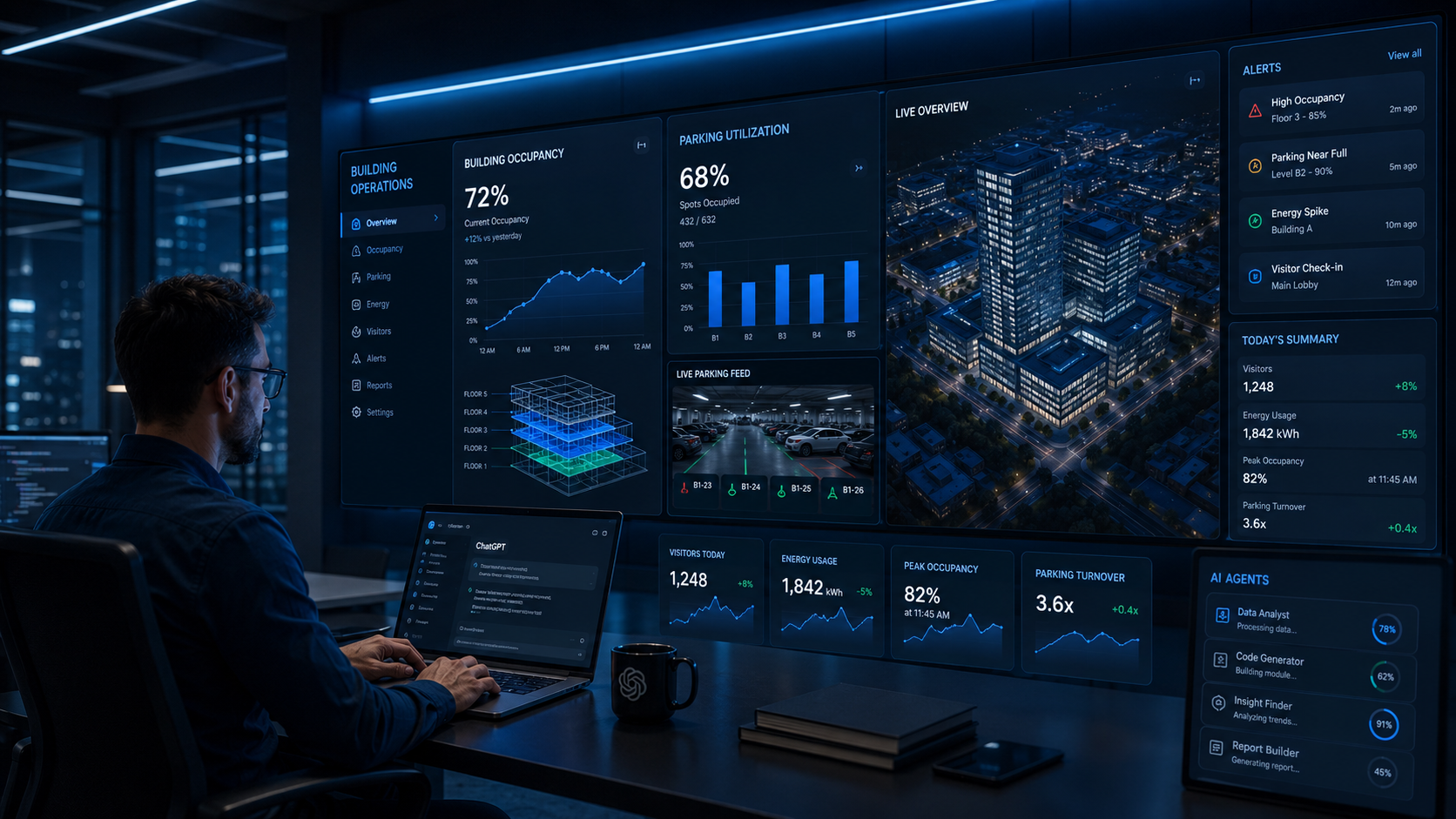
One recent project involved creating a dashboard that receives data from video analytics systems and presents it in a clear, business-friendly interface. The dashboard displays real-time occupancy levels, visitor statistics, parking utilization, and historical trends.
The development workflow starts with describing the business problem in natural language. Instead of writing every technical specification manually, I explain the objective to ChatGPT and ask for a proposed architecture. The AI helps define the data flow, backend services, database structure, and frontend components.
Coding agents then take the process even further. They can create new files, update existing code, refactor components, and resolve implementation issues directly inside the development environment. Rather than spending hours searching through documentation, I can focus on the desired outcome.
For example, I might ask:
"Add a parking occupancy chart for the last 24 hours and display a warning indicator when utilization exceeds 90%."
The coding agent analyzes the project structure, identifies the relevant files, and generates the required implementation.
The resulting dashboard provides real-time visibility into building occupancy and parking usage while also delivering historical analytics for operational decision-making. Development cycles that previously required weeks can often be reduced to days or even hours.
The most important lesson is that AI does not replace industry expertise. Understanding customer requirements, operational workflows, and business objectives remains essential. What AI changes is the speed at which ideas can be transformed into working software.
For professionals working in surveillance, security, analytics, and operational technology, ChatGPT and coding agents have become powerful tools for building practical solutions that deliver measurable business value.