Original article excerpt
Server-side extracted preview paragraphs from the original source.
Financial institutions have spent years building AI: fraud models, credit models, recommendation engines and risk systems. While this sprawl of task-specific models has been effective, it’s also constrained by siloed systems.
Financial institutions have spent years building AI: fraud models, credit models, recommendation engines and risk systems. While this sprawl of task-specific models has been effective, it’s also constrained by siloed systems.
Siloed systems prevent institutions from developing a unified understanding of consumers’ financial behavior. As enterprise datasets keep growing, so does the gap between what institutions know and what their AI can reason over — creating a major opportunity for the industry to build intelligence using proprietary data.
NVIDIA’s 2026 State of AI in Financial Services report shows 65% of institutions now use AI, with nearly 90% deploying or assessing it and almost all maintaining or increasing spend. But as AI scales, so does complexity, and fragmented model architectures become the limiting factor.
Leading firms are tackling this challenge by rethinking the architecture itself. Where the industry once relied on statistical and machine learning algorithms purpose-built for each line of business, transformer-based transaction foundation models now make it possible to learn a single, unified representation of consumer behavior trained entirely on proprietary data.
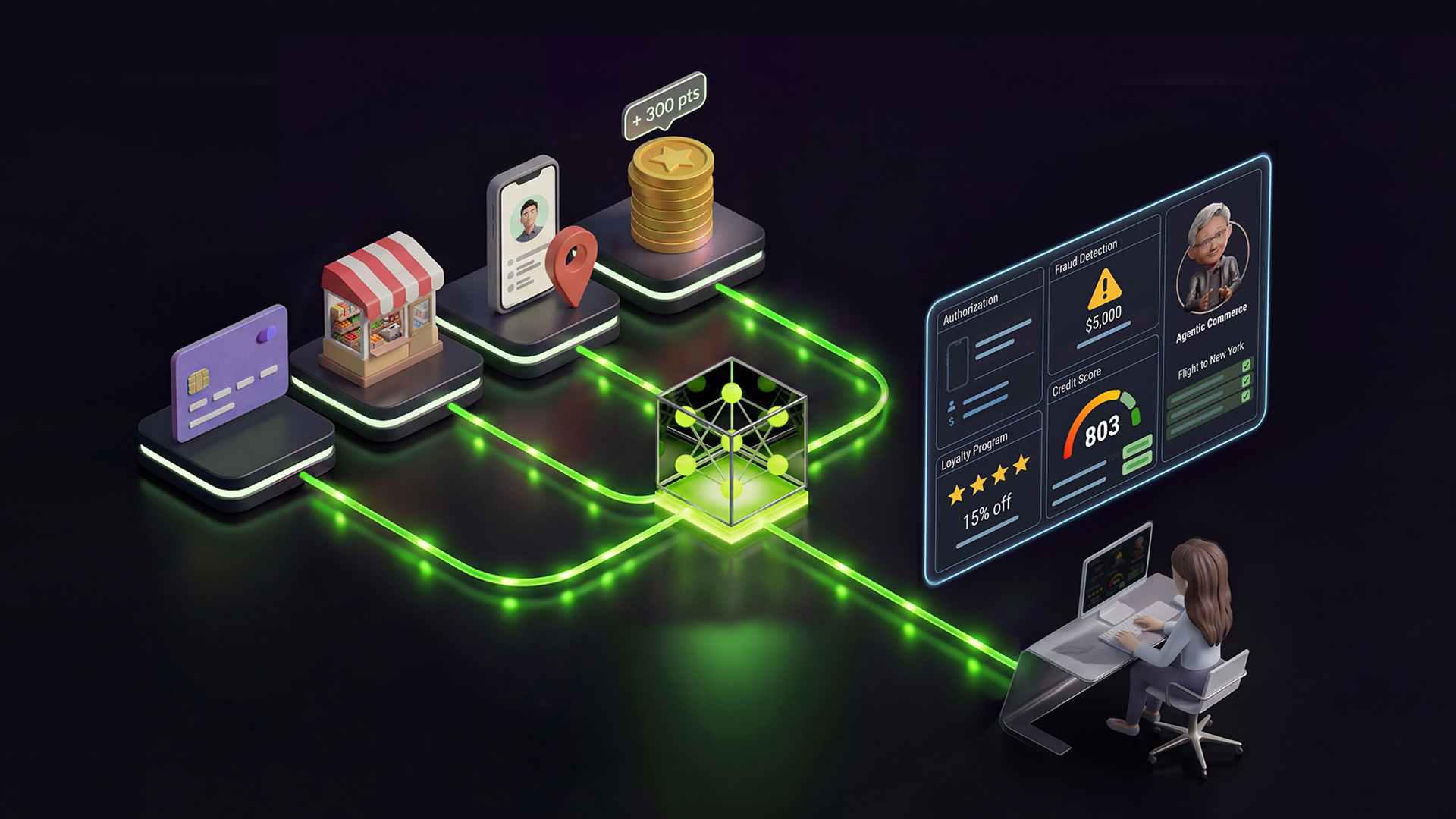
Transaction foundation models are large-scale AI systems trained on billions of financial events — such as payments, transfers, product interactions and behavioral signals — that transform raw data into intelligence, helping firms better serve their customers.
The shift is structural. A traditional fraud model evaluates isolated signals. A foundation model interprets behavior in context where timing, device, location and prior activity shape meaning. More importantly, it brings the power of transformer architectures to tabular data, extracting signals previously invisible to traditional algorithms.