Original article excerpt
Server-side extracted preview paragraphs from the original source.
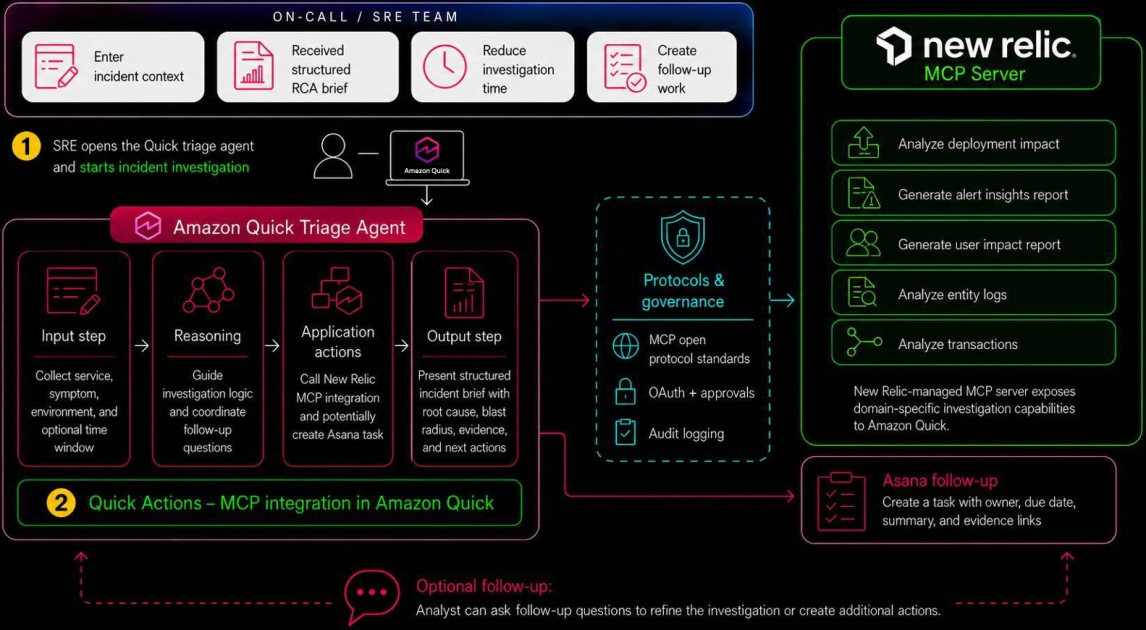
This post shows engineering teams how to apply that principle to one of the most time-sensitive workflows in engineering: incident triage. You will build a custom incident triage assistant agent using Amazon Quick that orchestrates a response with the New Relic Model Context Protocol (MCP) Server and Asana through native integrations. From a single prompt, the Amazon Quick agent investigates the incident, assembles a root cause analysis (RCA) brief with evidence links, and creates a tracked Asana task ready for handoff.
Incident triage is time-sensitive because site reliability engineers (SREs) and support engineers often need to collect evidence, assess user impact, and create follow-up work across separate tools. With Amazon Quick and New Relic, you can coordinate those investigation and handoff steps in a single conversational workflow.
This post shows engineering teams how to apply that principle to one of the most time-sensitive workflows in engineering: incident triage. You will build a custom incident triage assistant agent using Amazon Quick that orchestrates a response with the New Relic Model Context Protocol (MCP) Server and Asana through native integrations. From a single prompt, the Amazon Quick agent investigates the incident, assembles a root cause analysis (RCA) brief with evidence links, and creates a tracked Asana task ready for handoff.
For engineering leaders, reducing mean time to resolution (MTTR) is one way to drive better business impact. In internal testing using New Relic’s own applications, the agent reduced the evidence-gathering phase of incident triage. This led to faster resolution, lower risk of knowledge loss between engineering shifts, and a consistent investigation standard across the entire on-call rotation.
The incident triage assistant pattern in this post is one application of a broader capability in Amazon Quick: connecting enterprise tools to AI agents through native integrations.
With Amazon Quick chat agents, you can explore data and take actions through open-ended conversations backed by connected action connectors, pre-built integrations that link Amazon Quick to external services. New Relic is a built-in connector in Amazon Quick, providing access to its AI reasoning tools for incident response and performance analysis. Asana is another Amazon Quick built-in connector that supports task creation. The agent orchestrates both, producing an RCA brief and an Asana task from a single prompt. There are five New Relic reasoning tools the agent uses.
These tools do the investigative work, and the agent decides which ones to call based on your prompt: