Original article excerpt
Server-side extracted preview paragraphs from the original source.
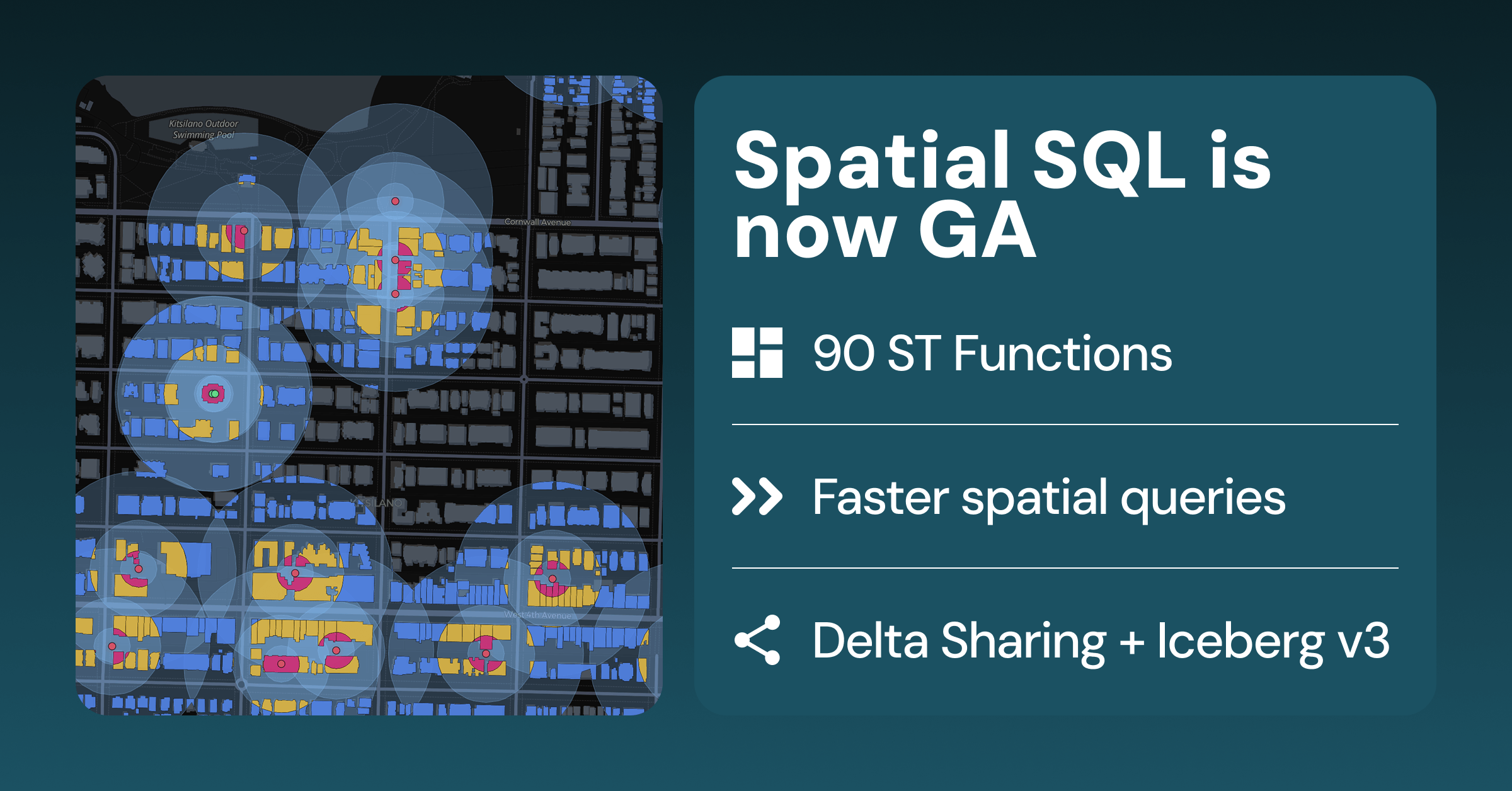
Spatial SQL on Databricks is now GA with improved performance, native maps in AI/BI dashboards, Delta Sharing for geometry and geography, and Iceberg v3 interoperability.
A hurricane is forming in the Florida Gulf. As an insurer, you need to answer key questions for the business immediately: identify the policies inside the projected storm paths, the total insured value at risk, the worst-exposed counties, and which reinsurance partners need to be notified.
Not long ago, answering these spatial questions meant stitching together multiple systems: a spatial database for the intersections, a warehouse for the policy data, and a visualization tool mapping results to share with analysts and underwriters. You might even have replicated the policy data within an external system. Every extra system adds risk, and every copy of data fragments governance.
Today, spatial work can happen on one platform. Spatial SQL is now Generally Available. Databricks is a geospatial lakehouse. The era of bolting a spatial database onto a warehouse onto a mapping tool is over. Store data as Geometry in Iceberg or Delta, run spatial queries at scale, call 90+ spatial functions, share through Delta Sharing, and explore in Genie, while Unity Catalog handles the governance.
Within the time-crunch caused by an approaching hurricane, every second counts. This is why we have continuously improved out-of-the-box performance of spatial joins and ST_ functions since Public Preview. To measure the latest improvements, we ran a comprehensive benchmark using SpatialBench. Across SpatialBench, 8 of the 12 queries improved since Public Preview, with gains ranging from 20% to 15X.
For boolean set operations (ST_Intersection, ST_Difference, ST_Union) we’ve introduced improved algorithms. These functions can help answer questions like, “Which parts of my land parcels lie inside the projected hurricane path?” and “What's the combined coverage of all our cell towers in this area?” Databricks is now 2X faster on average working with areal datasets using these operators compared to the prior versions. No code changes required, your existing queries just got faster.
These are the spatial operations that drive efficiency for Databricks customers like Top Chrono, who specialize in Premium Courier and Last-Mile Delivery services.