Original article excerpt
Server-side extracted preview paragraphs from the original source.
Mission, Vision and Veritas supercomputers with Vera CPUs to advance materials simulation, scientific AI agents and molecular design.
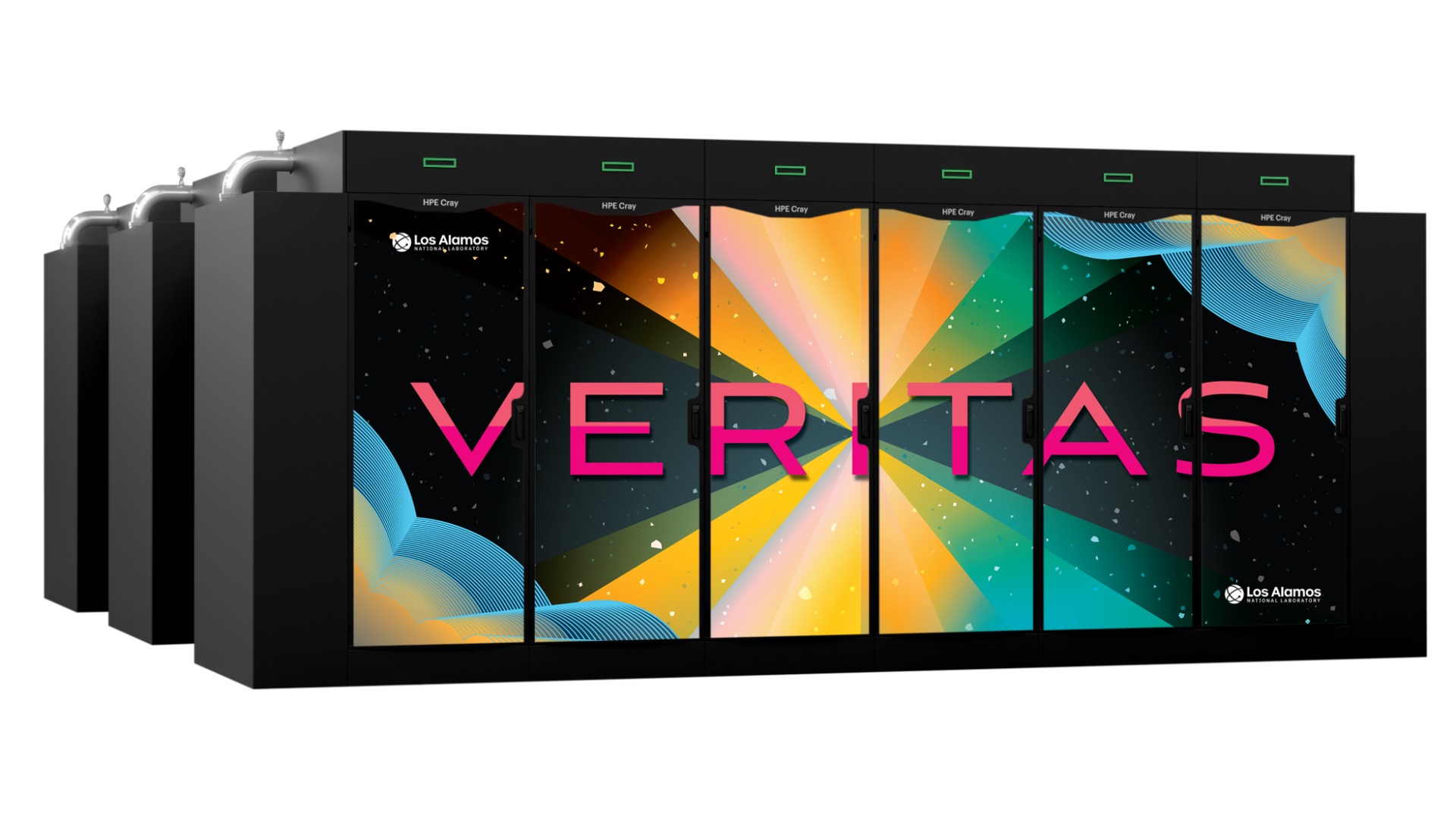
Mission, Vision and Veritas — new Los Alamos National Laboratory (LANL) supercomputers to be built with HPE and NVIDIA — are tapping NVIDIA Vera CPUs to accelerate scientific discovery, unlocking agentic AI for science.
The supercomputers will use the HPE Cray Supercomputing GX5000 architecture with the NVIDIA Vera Rubin platform, combining NVIDIA Vera CPUs, NVIDIA Rubin GPUs and NVIDIA Quantum-X800 InfiniBand networking.
Under the planned configuration, Mission will include NVIDIA Vera Rubin GPU nodes and 2,300 standalone NVIDIA Vera CPUs using the HPE Cray Supercomputing GX240 blade. Veritas will feature approximately 1,150 standalone NVIDIA Vera CPUs to complement NVIDIA Vera Rubin nodes.
Veritas will arrive alongside Mission and Vision and serve the Laboratory Directed Research and Development program, helping accelerate agentic AI for science. The system will test these technologies for use in larger systems being built out at LANL.
Researchers are adding a new tool for science with AI agents that can form hypotheses, choose tools, launch simulations, analyze outputs and refine the next step. LANL’s public work on URSA, the Universal Research and Scientific Agent — running on Venado and soon Mission and Vision — points in this direction: a modular, feedback-driven AI framework designed to help scientists brainstorm hypotheses, plan experiments, run simulations and analyze results.
LANL demonstrated that the Vera CPU delivered 7x higher performance on URSA workloads than the CPUs in the Crossroads x86 supercomputer.