The Verge AIPolicyHeat 61
Reported poll data released 2026-09-15 by The New York Times and Siena University found that 61 percent of 1,503 likely voters surveyed in early September 2026 opposed constructing data centers to power AI technology, while 14 percent strongly supported it. Claim risk: OPINION; assertion status: reported; requires secondary source.
Business relevance: Businesses pursuing data center construction for AI technology may face public opposition and related stakeholder concerns. No monetary amounts or availability dates were provided.
AWS Machine Learning BlogAgentsHeat 49
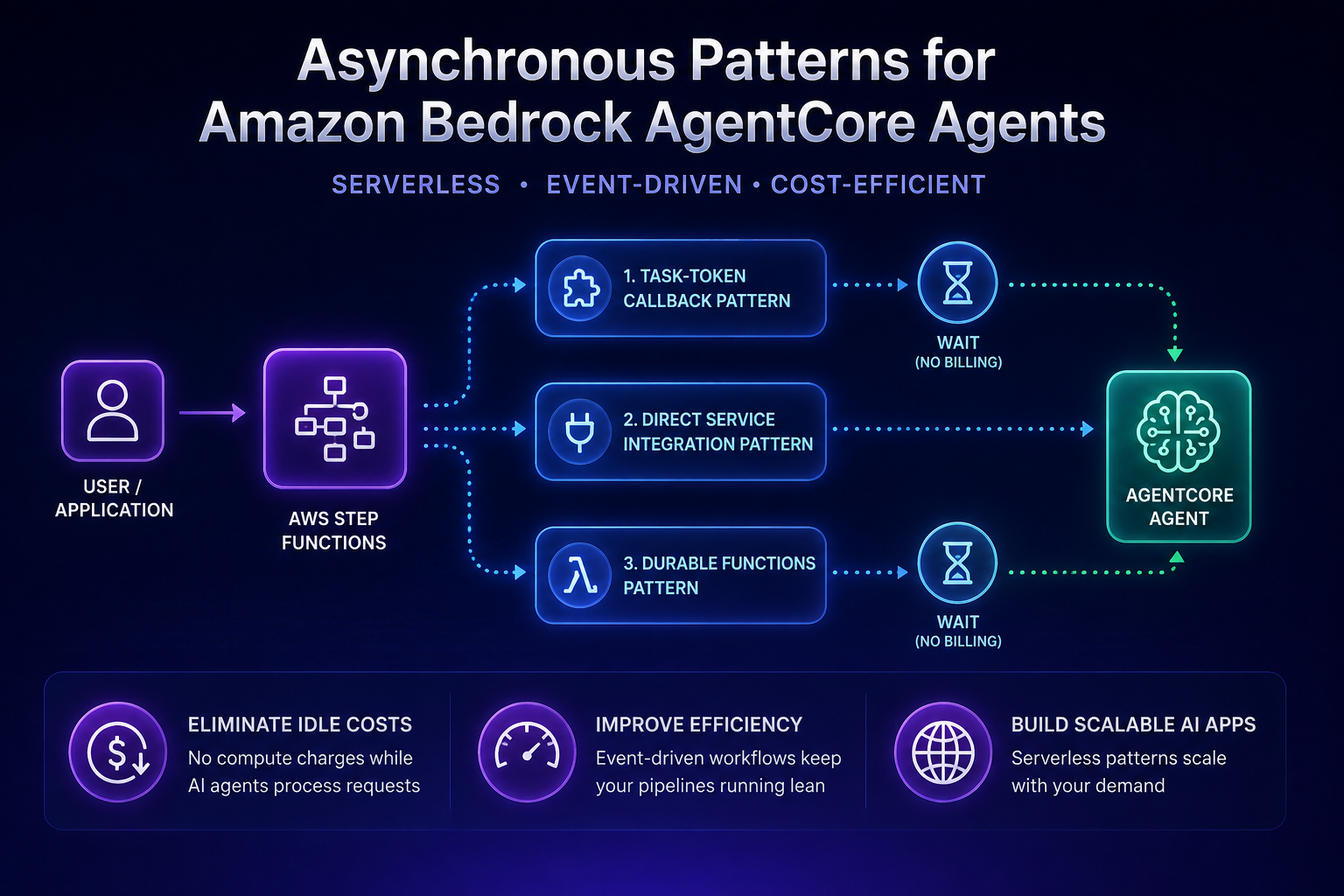
On 2026-08-19, AWS published a blog post detailing three serverless patterns—task-token callback, direct service integration, and durable functions—for asynchronously invoking Amazon Bedrock AgentCore agents from AWS Step Functions pipelines. These patterns eliminate idle compute costs while the AI agent processes requests.
Business relevance: By adopting these asynchronous invocation patterns, businesses can optimize resource utilization and lower cloud compute costs when integrating Amazon Bedrock AgentCore agents into their serverless pipelines.

TechCrunch AIInfrastructureHeat 49
Alphabet, Google's parent company, is reportedly developing a new AI chip aimed at improving the efficiency of its Gemini models, according to a report published on 2026-07-20.
Business relevance: The new chip could provide Alphabet and Google with a competitive advantage by optimizing their AI capabilities, enabling more advanced applications and services while potentially reducing infrastructure expenses.
NVIDIA BlogInfrastructureHeat 49
On 2026-07-20, Bristol Myers Squibb (BMS) announced the deployment of its second NVIDIA DGX SuperPOD, further advancing its AI capabilities in the life sciences industry. This expansion builds one of the most advanced AI factories in the sector, leveraging NVIDIA's technology.
Business relevance: By doubling its AI infrastructure, BMS is positioned to improve research efficiency and outcomes, maintaining a competitive edge in life sciences through cutting-edge AI applications.
AWS Machine Learning BlogInfrastructureHeat 42
Smartsheet developed a remote MCP server using AWS infrastructure. The architecture emphasizes security, governance, scaling, and deployment. AI-specific optimizations were integrated to enhance performance on AWS.
Business relevance: Improved AI deployment efficiency and governance can reduce costs and risks.
Hugging Face BlogInfrastructureHeat 49
NVIDIA NeMo Automodel now supports fine-tuning of video and image models at scale. This integration works with Hugging Face's Diffusers library to simplify model customization. It enables developers to efficiently adapt generative models for specific tasks and datasets.
Business relevance: Companies can reduce time and cost to deploy customized video and image AI solutions.

NVIDIA BlogInfrastructureHeat 59
NVIDIA introduced Vera Rubin, a system designed to maximize intelligence per dollar for post-training AI workloads. It achieves the lowest cost per token through extreme codesign optimization. This advancement is crucial for cost-effective agentic AI development.
Business relevance: Businesses can reduce operational expenses while improving AI performance.

TechCrunch AIInfrastructureHeat 51
A $400 million loan secured by inference chips highlights a shift in AI infrastructure financing. Early GPU investors are now focusing on inference chip technology. This deal signals growing confidence in specialized AI hardware beyond GPUs.
Business relevance: This could accelerate development and adoption of inference-optimized AI chips in the industry.

VentureBeat AIInfrastructureHeat 42
Enterprises are rapidly increasing AI infrastructure spending but struggle to measure its true costs. Most rely on hyperscalers and model-provider APIs, yet plan to evaluate specialized AI clouds and alternative accelerators soon. GPU utilization is low, and fewer than half rigorously track compute costs, creating a significant visibility gap in AI economics.
Business relevance: This gap may lead to wasted investment and challenges in optimizing AI compute resources.
Hugging Face BlogAgentsHeat 59
NVIDIA's Nemotron 3 Embed model achieved the top rank on the Retrieval-Enhanced Transformer Benchmark (RTEB). This advancement improves agentic retrieval capabilities, enhancing how AI agents access and utilize information. The achievement highlights NVIDIA's leadership in retrieval-augmented AI models.
Business relevance: Improved retrieval models can enhance AI assistant accuracy and efficiency in enterprise applications.
NVIDIA BlogRoboticsHeat 68
NVIDIA has launched the Jetson Thor T3000 and T2000 modules to support mainstream robotics and edge AI applications. These compact, power-efficient AI supercomputers are designed to run foundation models at the edge. This advancement helps move autonomous machines from research labs to real-world mass-market deployment.
Business relevance: Companies can develop and deploy advanced AI robotics solutions more efficiently and cost-effectively.

TechCrunch AIInfrastructureHeat 42
New York State has temporarily stopped approving new large data centers. Governor Kathy Hochul cites concerns about rising electricity costs, water supply, and local governance. This move is the first of its kind in the U.S. and targets the AI-driven data center boom.
Business relevance: Data center developers face delays and increased uncertainty in New York.